There is a reason why Rome is known as the Eternal City. Its history spans millennia and traces of its glorious past are clearly visible around the city and there are many stories and legends about it.
We all know its monuments and attractions, we have often also told you about its most secret places, but are you sure you know everything about Rome? Here are 10 curiosities you should know before visiting the city.
10 Curiosities about Rome
Rome's Nasoni
Sampietrini
The Cats of Rome
The hills of Rome
The oldest bridge in Rome
Tomb of Nero
Rome is the city with the most churches in the world
Monte Testaccio, the first landfill
Rome's ancient street food
The Alchemical Gate of Rome
 "/>
"/>
10 things you may not know about Rome
Rome is the city of fountains
Strolling around the city, you will certainly have seen numerous fountains; what you may not know is that there are about 2,500 of them in the city. These are the nasoni, which tell of Rome's ancient and profound relationship with water. The shape of the fountains in the city has changed over the centuries. While they were initially decorated with dragon heads and consisted of three spouts, they were later replaced by the curved-shaped pipe that earned them the name nasone.
 "/>
"/>
Sampietrini
The sampietrini are the historic paving stones of Rome. They have a very ancient history: they were in fact invented in the 16th century to facilitate the passage of carriages. They are characterised by blocks of leucite and exist in different types and sizes: the largest measure 12×12×18 cm; the most common measure 12×12×6 cm; and the smallest, 6×6 cm.
SEE ALSO: WHY YOU MUST VISIT BOGHERSE GALLERY
The cats of Rome
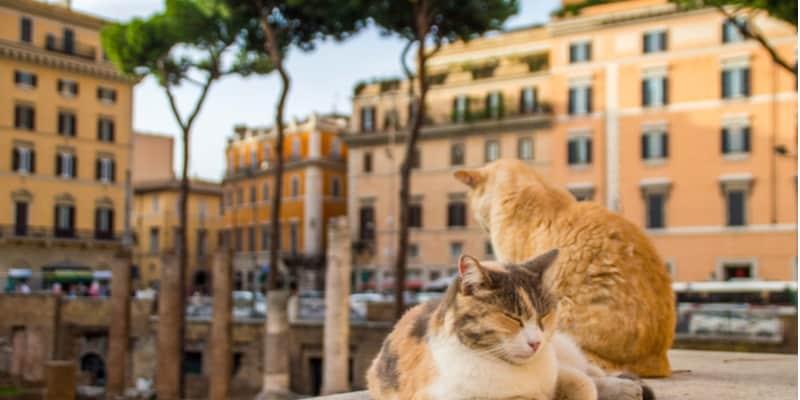
There are an estimated 300,000 cats in Rome that are allowed to run free. Yes, because there is a law that protects cats and states that if at least five cats live together, they cannot be separated.
Cat lovers can find a large cat sanctuary at Largo di Torre Argentina.
The Hills of Rome are (no longer) 7
Known to the world as the city of seven hills, it actually has more. This is because over the centuries it has expanded its boundaries from the original settlement. The historic hills are the Aventine, Caelian, Esquiline, Quirinal, Viminal, Capitoline and Palatine. To these must be added the Vatican, Pincio and Janiculum hills.
The oldest bridge in Rome
The Fabricio Bridge is the oldest bridge in the capital, which has maintained its original layout for more than 2000 years. Compared to the Ponte Milvio or the Ponte Sublicio that were made of wood and were rebuilt, the bridge connecting the Tiber Island has always had that conformation. There is also a legend that hovers over this bridge and revolves around the diatribe between the four architects commissioned by Sixtus V to restore the bridge. At the end of the work, the Pope condemned them to be beheaded by having a monument made with four heads in a single block of marble: this is why the bridge is known as the Four Heads Bridge.
 "/>
"/>
Tomb of Nero
Right where the Church of Santa Maria del Popolo stands today, Nero is said to have been buried. According to legend, he was buried under a thick walnut tree surrounded by black crows. Pope Paschal II in 1099 decided to cut down the walnut tree because it was said to be a haunt of witches and holy men who tormented Nero's soul, had the emperor's remains exhumed and scattered the ashes in the Tiber. In the same place he eventually built the church of Santa Maria del Popolo.
 "/>
"/>
Rome has the most churches in the world
Rome is the city with the most churches in the world, in fact there are 900 in the city. Among the oldest are the Basilica of Santa Prudenziana and the church of Santa Prisca.
Monte Testaccio, Rome's first rubbish dump
Monte Testaccio, also known as Monte dei cocci, is an artificial hill about 36 m high that can be found in the 20th district of the same name, between the Aurelian walls and the left bank of the Tiber. Its name derives from the Latin mons testaceus: this is because it is composed of layers of shards from over 53 million terracotta amphorae used to transport goods (such as oil) that were unloaded here.
This is why it is known as the first dump in the city.
 "/>
"/>
The oldest street food
Street food already existed in ancient Rome. Along the streets of the city it was easy to find the Lixae, or street vendors who offered food to passers-by including bread and pancakes.
The Alchemical Gate of Rome
In Piazza Vittorio, at the Esquiline, there is a curious assemblage of statues and esoteric symbols. The Porta magica, also known as Porta Alchemica, is one of the most significant remains of Villa Palombara, a majestic villa that stood on the Esquiline Hill before the urbanisation of the area. According to legend, the gate was connected to the philosopher's stone and the eccentric studies of the well-known alchemist who owned the villa.
Italy
Latium
Rome